Tiger Global invests in Automattic

We shared some exciting news today that Tiger Global has made a $50mm investment in Automattic.

From our CEO Toni

Tiger Global has recently invested over $50M in Automattic secondary stock purchases. After many years of being backed by a great team of investors who have been with Automattic since the early days – Polaris Partners, True Ventures, Radar Partners, and the New York Times Company – Tiger has joined this illustrious group by purchasing shares from early Automattic investors and employees. Along with the on-going growth of WordPress (now powering over 18% of sites on the internet) and the amazing Automattic team (now over 170 employees), this investment is another milestone in our journey towards building a great company.

It’s noteworthy that Tiger has recently invested in companies like SurveyMonkey and Eventbrite, and before that companies like LinkedIn and Facebook. Those names provide a sense of how far Automattic has come and how we’re poised to enter an exclusive circle of successful software companies that are built to last.

And from our founder Matt:

Anyway, wanted to get in front of the news that will inevitably come out in the next week or two: there has been a large secondary transaction in Automattic stock, about $50M worth. “Secondary” means that it’s existing stockholders, like the earliest investors or employees, selling stock to another investor versus money going into the company (“primary”). It was led by Lee Fixel at Tiger Global, one of the behind-the-scenes quiet geniuses that has previously invested in SurveyMonkey, Facebook, LinkedIn, Palantir, Square, Warby Parker… Automattic is healthy, generating cash, and already growing as fast as it can so there’s no need for the company to raise money directly — we’re not capital constrained.

Plus always gratifying to see the reactions from our friends:

WordPress on Google App Engine

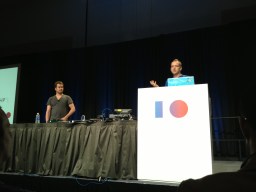
I’m at Google I/O right now and they just ran a demo of WordPress running on App Engine and using Jetpack to tweet out via the Publicize feature. Cool stuff:

UPDATE: here is the video of the session:

Enabling Google Now on iOS and use Google Apps ? Head to your admin settings

Google just updated it’s main (and under appreciated) “Google Search” iOS app to include Google Now support, which was Android-only up until now.

I updated the app on my iPhone, but it didn’t work, and asked that I check some settings.

Turns out if you are running Google Apps, you need to enable Google Now under the main google apps dashboard in the Mobile settings for “Android”:
google-apps-google-now-ios
Not super intuitive 🙂

What is Google Now ? Here is an overview video below:

USC Talk & a surprise about Snapchat usage

I gave a talk at USC earlier this week about Automattic and WordPress — something I’ve done for 3 years in a row now.

It’s always a ton of fun, and I make sure to do a survey (by show of hands) each time to see what these undergrad & grad students are using in terms of popular services.

Here are the results:
WordPress: about 75%+ use WordPress in some capacity
Facebook: 100%
Twitter: about 75%
Tumblr: 33%
Note taking: Evernote vs Simplenote vs Pen & Paper: About 33% Evernote, the rest a combination of email, other apps, or nothing. And one person still using a pen & paper.
iOS vs Android: 75% iOS, 25% Android
SMS vs GroupMe vs MessageMe vs Snapchat: SMS still used by everyone, but the surprise here was Snapchat being used by over 50% of the class.

I asked the obvious question of what they were using Snapchat for – and the answer was that it was just a free SMS-like service, easy to send media, works all over the world and w/ friends overseas — and basically that everyone is on it. Was pretty clear it’s moved beyond the salacious roots (or at least how it was covered early on).

So a big thanks to Zach Posner for having me, and for his entire class for engaging in a really fun and interesting discussion – appreciate the tweets and Instagrams too 🙂

https://twitter.com/lismanson/status/321498086654492672

https://twitter.com/jenflaks/status/321474624875548672
https://twitter.com/WizardofAudj/status/321474471905087488
http://instagram.com/p/X3rez6Rst8/

Uber and Waze need to start dating

uber-waze-datingEveryone knows I love Uber – better than a taxi in almost all respects, and about the same price for rides longer than 10 minutes (and often cheaper than a taxi for even longer rides). I’m equally obsessed with Waze – a crowd sourced community based GPS/traffic/navigation app that navigates you around traffic, alerts you to accidents, and ultimately gets better the more people use it.

If you are like me, you will occasionally find yourself sitting in the back of an Uber loading up Waze to see how long it will take to get to your next meeting or if you’ll catch your flight. And what you often find is that the driver, although well intentioned and very knowledgeable of the city, doesn’t have a full 360 view of ongoing traffic patters and accidents, and can’t pick the best route the way the Waze app can. A true #firstworldproblem :).

So you watch your ETA slowly get later, and you hesitate to give the driver some advise on routes without coming across as this arrogant back-seat-driver.

When I see this happen I usually ask the driver if he or she has heard of Waze — and about 5% of the time they have but they rarely have it available or installed.

So my suggestion: Uber should add a “Waze option” where it’s bundled on the iPhone of the driver, or integrated into the app itself – and give the passenger the option of having the Uber driver just follow the best route as chosen by Waze.

It’s a an easy win for both companies, and gives peace of mind to the passenger.

Weekend Reading: Why Medical Bills Are Killing Us & The Extraordinary Science of Addictive Junk Food

Two really very thoughtful and interesting articles I read this weekend.

The first, a TIME cover story, Bitter Pill: Why Medical Bills Are Killing Us, talks about how hospitals set the fees from everything from Tylenol to CTs, and how steep the markups are for what are suppose to be non-profit institutions:

On the second page of the bill, the markups got bolder. Recchi was charged $13,702 for “1 RITUXIMAB INJ 660 MG.” That’s an injection of 660 mg of a cancer wonder drug called Rituxan. The average price paid by all hospitals for this dose is about $4,000, but MD Anderson probably gets a volume discount that would make its cost $3,000 to $3,500. That means the nonprofit cancer center’s paid-in-advance markup on Recchi’s lifesaving shot would be about 400%.

When I asked MD Anderson to comment on the charges on Recchi’s bill, the cancer center released a written statement that said in part, “The issues related to health care finance are complex for patients, health care providers, payers and government entities alike … MD Anderson’s clinical billing and collection practices are similar to those of other major hospitals and academic medical centers.”

The hospital’s hard-nosed approach pays off. Although it is officially a nonprofit unit of the University of Texas, MD Anderson has revenue that exceeds the cost of the world-class care it provides by so much that its operating profit for the fiscal year 2010, the most recent annual report it filed with the U.S. Department of Health and Human Services, was $531 million. That’s a profit margin of 26% on revenue of $2.05 billion, an astounding result for such a service-intensive enterprise.

The president of MD Anderson is paid like someone running a prosperous business. Ronald DePinho’s total compensation last year was $1,845,000. That does not count outside earnings derived from a much publicized waiver he received from the university that, according to the Houston Chronicle, allows him to maintain unspecified “financial ties with his three principal pharmaceutical companies.”

The author of this cover story, Steven Brill was also interviewed on the Daily Show, and it’s definitely worth watching.

The other piece is a NYT Magazine cover story, The Extraordinary Science of Addictive Junk Food looks into how processed food is made and marketed, and partly about the dilema that these companies face – which is when they put out nutritional food, it sells poorly (or doesn’t work b/c of the long shelf life requirements). Yet when they load it up with sugar and salt, it sells well. The story also goes in to how these foods are marketed at kids and busy working moms — really interesting stuff:

Mudd then presented the plan he and others had devised to address the obesity problem. Merely getting the executives to acknowledge some culpability was an important first step, he knew, so his plan would start off with a small but crucial move: the industry should use the expertise of scientists — its own and others — to gain a deeper understanding of what was driving Americans to overeat. Once this was achieved, the effort could unfold on several fronts. To be sure, there would be no getting around the role that packaged foods and drinks play in overconsumption. They would have to pull back on their use of salt, sugar and fat, perhaps by imposing industrywide limits. But it wasn’t just a matter of these three ingredients; the schemes they used to advertise and market their products were critical, too. Mudd proposed creating a “code to guide the nutritional aspects of food marketing, especially to children.”

“We are saying that the industry should make a sincere effort to be part of the solution,” Mudd concluded. “And that by doing so, we can help to defuse the criticism that’s building against us.”

What happened next was not written down. But according to three participants, when Mudd stopped talking, the one C.E.O. whose recent exploits in the grocery store had awed the rest of the industry stood up to speak. His name was Stephen Sanger, and he was also the person — as head of General Mills — who had the most to lose when it came to dealing with obesity. Under his leadership, General Mills had overtaken not just the cereal aisle but other sections of the grocery store. The company’s Yoplait brand had transformed traditional unsweetened breakfast yogurt into a veritable dessert. It now had twice as much sugar per serving as General Mills’ marshmallow cereal Lucky Charms. And yet, because of yogurt’s well-tended image as a wholesome snack, sales of Yoplait were soaring, with annual revenue topping $500 million. Emboldened by the success, the company’s development wing pushed even harder, inventing a Yoplait variation that came in a squeezable tube — perfect for kids. They called it Go-Gurt and rolled it out nationally in the weeks before the C.E.O. meeting. (By year’s end, it would hit $100 million in sales.)

According to the sources I spoke with, Sanger began by reminding the group that consumers were “fickle.” (Sanger declined to be interviewed.) Sometimes they worried about sugar, other times fat. General Mills, he said, acted responsibly to both the public and shareholders by offering products to satisfy dieters and other concerned shoppers, from low sugar to added whole grains. But most often, he said, people bought what they liked, and they liked what tasted good. “Don’t talk to me about nutrition,” he reportedly said, taking on the voice of the typical consumer. “Talk to me about taste, and if this stuff tastes better, don’t run around trying to sell stuff that doesn’t taste good.”

The Red Hat Experience

From Early Employees: Paul McNamara & The Red Hat Experience – a great interview by Hunter Walk:

Q: When you look at how open source technology has evolved, what’s consistent with your original thinking and what surprises you?

A: I knew from the beginning that Open Source Software (OSS) would change the world. Before OSS, software development was a feudal system where only an elite few could contribute. OSS democratized software development and upending the power structures of the industry. Anyone with interest, energy and skill (whether obtained formally or not) could contribute. This was a powerful idea.

But I’m still surprised by how fundamentally OSS has changed the technology landscape. It is safe to say that without OSS, the Internet would today be a mere shadow of itself. Most people outside of the tech industry don’t realize that most of the internet is built on OSS. By extension, I also think that much of cloud computing owes its existence to OSS. But beyond that, OSS has changed how software start-ups operate.

Chris Dixon on The credentials trap

Chris Dixon has a great post on “The credentials trap”:

I talk a lot to people who are deciding between startups and established companies. They’re usually early in their careers and have been exclusively affiliated with well-known schools and companies. As a result, they’re accustomed to praise from family and friends. Going to a startup is scary, as Jessica Livingstone, cofounder of Y Combinator, describes:

Everyone you encounter will have doubts about what you’re doing—investors, potential employees, reporters, your family and friends. What you don’t realize until you start a startup is how much external validation you’ve gotten for the conservative choices you’ve made in the past. You go to college and everyone says, “Great!” Then you graduate get a job at Google and everyone says, “Great!”

But optimizing for external validation is a dangerous trap. You’re fighting over a fixed pie against well-credentialed peers…

Full post on cdixon.org