
37.774929
-122.419415
Very cool to see this live. All the blogs from MLBlogs.com are now on WordPress.com, including ones from players, fans, and commentators such as Keith Obermann. These blogs were previously on a MovableType installation.
In addition, three new MLB branded baseball themes are available today to over 20M publishers on WP.com via the WP.com theme gallery.
Play Ball ! And check out the full announcement post here for all the details.
Super excited about our new launch of the Onswipe theme/plugin today.
Here is Matt’s food blog viewed from an iPad:
 .
.
A few more details:
There are some fun options to play with too. If you browse to Appearance -> iPad in your Dashboard you can:
– Have the theme use an image from your recent posts as a cover.
– Upload a logo to showcase your brand or personality on the cover.
– Upload an image to be used as a loading graphic when visitors add your site to their home screen.
– Switch fonts.
– Choose from 9 different skin colors, to best match the feel of your site.
– Enable or disable the whole thing.
So fire up raanan.com on your iPad and let me know
Read more on the announcement post on WordPress.com.
Ran across this fascinating article, Polaroid and Apple: Innovation Through Mental Invention from Fast Company – which excerpted a few section from the book, Ten Steps Ahead: What Separates Successful Business Visionaries from the Rest of Us.
Steve Jobs admits to few idols. But one is Edwin Land, the college dropout who invented the polarizing filters used in everything from car headlights to sunglasses. Land, of course, also invented the Polaroid Land Camera. It happened like this: One time when Land and his three-year-old daughter were in New Mexico, she asked why she couldn’t immediately see a photograph that he had snapped. He took a short walk through the desert, pondering that question. By the time he had returned (and it was no more than an hour, he recalled), he had visualized the elements of the instant camera. “You always start with a fantasy,” he said. “Part of the fantasy technique is to visualize something as perfect. Then with experiments you work back from the fantasy to reality, hacking away at the components.”
…
Now, some 40 years later, Land had agreed to meet with Jobs at Land’s laboratory in Cambridge, Massachusetts. Jobs was on one side of the conference table, Land on the other. They were of different generations, but cut from similar cloth: Jobs, the dropout from Reed College; Land, the dropout from Harvard. Jobs, working nights inventing video games at Atari; Land, lifting a window and sneaking into a lab at Columbia University at night to use the school’s equipment. Jobs, neglecting his clothes and his health to build his PCs. Land, who in his prime worked 20 hours a day, forgetting to eat, and wearing the same clothes for days on end.
Land once told a reporter, “If anything is worth doing, it’s worth doing to excess … My whole life has been spent trying to teach people that intense concentration for hour after hour can bring out in people resources they didn’t know they had.” Similarly, Jobs had once remarked, “We have a short period of time on this earth … My feeling is that I’ve got to accomplish a lot of things while I’m young.”
Looks like a good read.
This year it feels like getting ready for the big SXSW event later this week requires trying out a dozen+ new mobile apps. I’ve been giving a few of them a go, and happy to find a few winners.
In the group messaging category, GroupMe, seems really useful — as well as Beluga, Hurricane Party app, and FastSociety.
My one complaint with nearly all of these apps — all the configuration happens within the app — the web component is pretty weak or an after thought. And putting 30+ contacts into a group on the iPhone, for example, is rather tedious. I think all these apps could benefit from a simple web UI that you do on setup, and then go mobile 95% of the time after that.
On the I-missed-this-while-in-Europe front, I completely missed the news that CardMunch got acquired by Linkedin and is now free. The service is dead simple — you take a photo of a business card — and then humans transcribe it into a contact-friendly format, and optionally sync it to Linkedin.
Been testing it out tonight, and seems to work really well, and will be great for events where you are meeting people and end up stacking up cards after you get home and rarely entering them in. I see a few comments about privacy concerns, but with Linkedin now owning them, I’m less concerned about that — they’ve been very solid on privacy protection.
Any other must-have apps ?
What I wouldn’t give to be a kid going up next week for ski week after this massive snow dump.
As Brian Lam tweeted out the other day:
http://twitter.com/#!/blam/status/37968917968191488
And here’s a pic of the beginner slopes that I took on w/ full force a couple of days ago 🙂

I’ve been reading the excellent new Tim Ferris 4-Hour Body book. Really fascinating stuff about optimizing your health, strength, and a host of other physical topics. Here’s the trailer for the book:
I’ve also watched Food Inc lately, followed by a few Netflix recommended flixs – Food Matters and Killer at Large: Why Obesity is America’s Greatest Threat.
And yes, I had no interest in almost any of this stuff when I lived in New York. Maybe it’s a left coast thing 🙂
My big takeaways from Tim’s book and these documentaries is the following:
– I personally spend more time researching smart phones and 3G/4G coverage maps then actually paying attention to what I eat and tracking my health. An annual doctor’s visit usually just results in “things look good” with very little other info.
– Given startup life and travel, I spend too much time either hungry but w/ no time to eat or feeling like I ate too much.
– I’ve never quite believed the whole “just burn more calerories than you consune” — doesn’t make mathematical sense, and anyone who has worked out knows, after an hour of cardio you have burned the equivalent of 5 bites of your dinner.
– For a few years I’ve been essentially following a modified version of the Mark Bittman system. Eating salads for lunch, and avoiding deserts unless the day starts with the letter “S”. This has been good — but not good enough.
– Tim ferris is a next generation hacker — very impressive what he’s done in his latest book — and really wish more people in the health field would take his approach of being data centric, and not making assumptions.
Things I’m going to do more of or have started to do already:
– Doing this a bit already, but even more focused on eating vegetables and meats that are organic and local
– I used Run Keeper for a few weeks to track my walking activity. Averaging now about 20M/week from just walking to cafes and to meetings. Going to try and track that a bit more.
– I picked up a Wifi enabled scale recently, Withings, which also tracks fat % and BMI (although fat % seems to not be super accurate)
– I started the 4HB recommended diet about a week ago, photo blogging each meal using the WP for iOS app and post-by-email.. Hat tip to Beau Lebens for the “system” suggestion 🙂 The diet essentially cuts out carbs, dairy, and sugars, and you eat as many vegetables as you want — plus you get one “cheat” day a week to eat anything you’d like. I’m not totally convinced that this is a long-term way of eating — but I think it’s helpful to “reset” a bit with one of these approaches, and then slowly add back certain foods to see if they have any real impact.
Conclusion:
– Data is good — just the act of tracking things is a step in the right direction
– I love Tim’s focus on MED – Minimally Effective Dosage. Yes you can work out 2hrs/day and get in good shape (assuming you don’t get injured), but what if you could get 80% of the work-out benefits from a 20 minute workout. That seems much more sustainable and smart to me, and that’s what Tim is focused on in terms of diet and workouts.
– Change is good — it’s fun to change things up food wise. And it forces you to get creative within a set of limitations and restrictions.
I’ll post in a few weeks to see how this whole 4HB thing works out 🙂
Pretty interesting and cool visualization feature from Linkedin that rolled out recently (side note, Linkedin’s blog is in our WP.com VIP program).
This visualization shows how your Linkedin contacts cluster based on your employer, different affiliations, and groups. Here’s mine: (click through to see the labels)
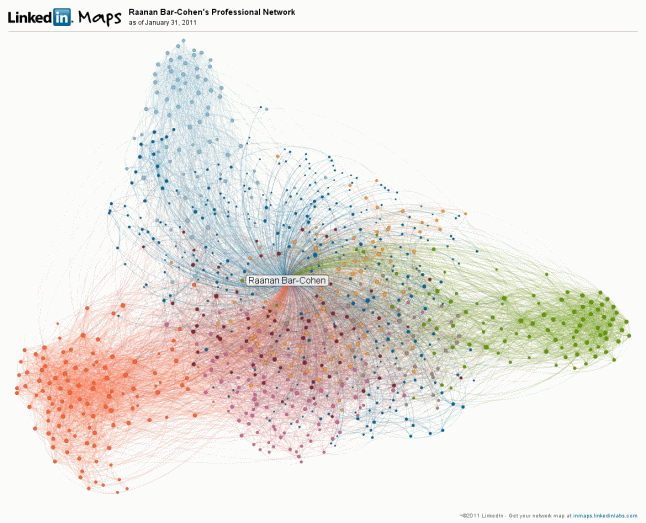


 Raanan Bar-Cohen
You must be logged in to post a comment.