Just flew past me !
news







Very excited to have such great companies join our partner program.

Earlier this year, we introduced a new partnership program where we’re working with technology platforms to integrate their services into our WordPress.com VIP platform, connect them with our VIPs, and collaborate to support the integration and provide a seamless experience for our users.
Some of the world’s biggest brands and publishers rely on WordPress.com VIP, and every day we connect our VIPs with top service providers for their WordPress development and design needs.
That’s why today we’re announcing the expansion of the Featured Partner Program to include interactive agency partners as well: 10up, Alley Interactive, Code for the People, Doejo, Human Made, inSourceCode, Oomph, Range, and Voce Communications are all joining as partners.
In addition to our agency partners, Facebook, Flipboard, PostRelease, Tinypass, and Zemanta are now a part of the program as well.
“As a team that relies heavily…
View original post 89 more words
Google Fiber and Social Engineering
It uses social engineering: It’s accepted that one of the most costly elements of building out a fiber network is the physical labor associated with strong cable, digging trenches and hiring people to terminate the fiber into the home. Google has already strung cable on power lines throughout Kansas City and lowered those costs by working with the local utility and AT&T to get access to the utility poles without having to pay high fees.
But to reduce the cost of the actual last mile to users’ homes it’s telling people in Kansas City that if they want to be the first to get fiber, they’ll have to convince their neighbors to sign up. The goal is to get a critical mass of between 5 percent and 25 percent of the homes in a given neighborhood (Google calls it a fiberhood) committed to signing up for Google Fiber before ever sending out technicians. Residents have until Sept. 9 to get their fiberhood on the leaderboard before Google starts rolling out its fiber.
Google’s Milo Medin and a Google fiber product manager.
Milo Medin, the VP of access services at Google, explained that with this model the folks in the first fiberhood will have their access within a week. This is also why the free service is so important to Google. If people buy into that process, it can get homes attached in those initial bulk deployments and reduce the number of times Google has to send out trucks and technicians. Medin says the $300 initial connection fee will cover the costs associated with the deployments — it’s not doing that at a loss either.
via http://gigaom.com/2012/07/26/the-economics-of-google-fiber-and-what-it-means-for-u-s-broadband/

Fortune Tech Brainstorming Conference in Aspen 2012
Last week I attended the Fortune Tech Conference (WP powered site) in Aspen.
A few interesting bits that I wrote down:
- Marc Andreessen’s opening interview was great, and he once again proved that he’s one of the smartest and most transparent leaders in our industry. (a16z.com and all their blogs, like Marc’s, are on WP.com VIP).
- “War for Tech Talent” session. Facebook is a strengths based organization, which means people are encouraged to work on what they love. Their data says that people are most happy and feel most accomplished when working on something they are good at and have a passion for. A good day for an employee @ Facebook is usually one that plays to that person’s strengths. For managers “focus on how each individual has impact”
- From the CEO of Intuit, Brad Smith, on how they view and deal with competition. One thing they do is that each quarter they have a “pick a fight with a new guy” session where Brad asks a product manager to focus on 3 competitors and decide how to track them, learn from them, and sometimes buy them (Mint).
- Tony Fadell (Apple iPod guy, now Nest), “fall in love with the problem” and “focus on what problem you are solving”
- Tony Fadell also talked about how we should let new new hires have the space to change the organization & ideally makes everyone better. And to not fall into the trap of forcing your own culture / DNA on them, otherwise you lose the ability to adapt and become too insular and fail to learn from the outside world.
- Mark Pincus: Mobile monitizing better than desktop. Why ? Way less friction for payments (huge) and higher net income demographic on smartphones today VS the global / even distribution on desktop web
- Eric Schmidt and Peter Thiel had a heated head-to-head debate on the role of tech that is definitely worth watching
At all events I feel like many conversations turn to new startups, interesting apps that you have installed, etc. This event was no different. Mike Green from Comcast had two gems that I’m checking out: Paper Karma which looks amazing “PaperKarma allows you to take photos of the junk mail you wish to stop. Snap a photo, and you’re done” and CarWoo which is a LendingTree style car service where car dealers compete for your business. (big AOL Autos deal just announced)
So a great event – I learned a bunch, and highly recommend attending. A big shout-out thank-you to John Cantarella and Adam Lashinsky (conference co-chair) for their hospitality.
Also a pro-tip for those flying from SFO to Aspen. I highly recommend you fly SFO->LAX->Aspen and avoid Denver airport, unless you enjoy a 4 hour drive to Aspen 🙂
Here are some quick photos from the trip:










How long does it take to become a true New Yorker ?
New Yorkers, especially those who have been there for at least 10 years, the length of time Ed Koch says it takes to be a real New Yorker …
From the awesome post on Gawker: I Used to Love Her, But I Had to Flee Her: On Leaving New York
Best thing I’ve read about what it’s like to live in NY and try to make it, why it’s so hard to leave or fathom living anywhere else, and then what it feels like to have left (I lived in NY for nearly 13 years before moving to the Bay Area).
Eight Fantastic Startups from the Zell Entrepreneurship Program
I had the privilege of hosting the 2012 Zell Entrepreneurship group the other week here in San Francisco as they wrapped up their big U.S. trip. They are a startup program at the IDC Herzliya – a top private university in Israel – which has produced some big companies such as Wibya.
The idea was to have some informal chats and also an ignite style 5 minute demo for each company:

I’ve been to a few demo days from various accelerators and VCs over the years, and this group was as good as any I’ve ever seen.
What was so amazing about this collection of companies was that each demo was polished, each company was solving a real issue (no vitamins here — all painkillers) – really impressive stuff. And a ton of credit has to go to Liat Aaronson – the Executive Director of the Zell Entrepreneurship Program – who also is the director of the StartUp Seeds, a young technology entrepreneurship incubator in Israel.
For those who are interested, here is who presented:
– HocSpot: Instant location based file sharing and communication. (So smart and useful — no more USB stick hand-offs, or dropbox links on Skype).
– Roomer: A peer to peer marketplace for buying and selling hotel room reservations. Taking advantage of a huge opportunity with room cancellations.
– 3Kudos: Crowd sourced web platform for revealing financial service fees and helping people negotiate better deals.
Ten Foot: Offering online merchants a way to increase revenues by automatically turning their online stores into engaging tablet experiences at low cost and in a few minutes.
Bigger Game: Is a smartphone app that brings the social experience of watching live sports events into your hands.
Crowdpic: Crowd sourcing photography for creating group albums and enhancing experiences together.
Jesta: A marketplace that allows people to outsource their daily errands.
Spoteam: A platform that delivers its users personalized and relevant video content, like Amazon for books and Netflix for movies.
And lastly — here is a a great infographic on what the Zell program has meant, impact wise:

How to Know What Powers that Website
Over on W3Techs they do great work analyzing which platforms power the top 1 million sites.
It’s a fascinating bunch of stats and insights into what is going on, and WordPress as a platform has the top spot with 16.6% overall, and over 54% of the content management systems:
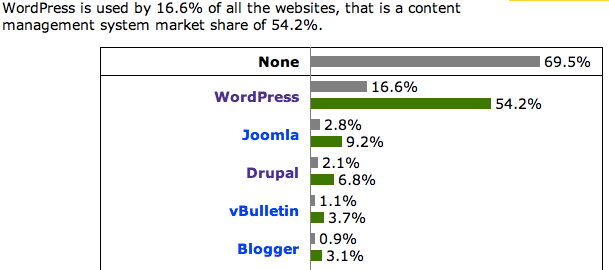
It’s hard to visualize that 16.6% number which is nearly 6 times larger than the next platform. It’s also very hard to know when you are on a WordPress powered site.
Unlike Twitter or Facebook which always have “twitter.com” or “facebook.com” in the address bar, tens of millions of WordPress sites are either self-hosted running their own domain, or on WordPress.com and running a mapped domain (as I do on this blog). So just because a site doesn’t live on “example.wordpress.com”, doesn’t mean it’s not using WordPress.
So how do you know when you are visiting a WordPress powered site ? You can view-source and look for some specifics, or check the http headers — but most of us won’t be doing that on a typical basis.
But there is an easier way. If you are running the Chrome browser, an extension called Chrome Sniffer will show you what is powering the site you are visiting by placing a small logo of that platform/service in the address bar:
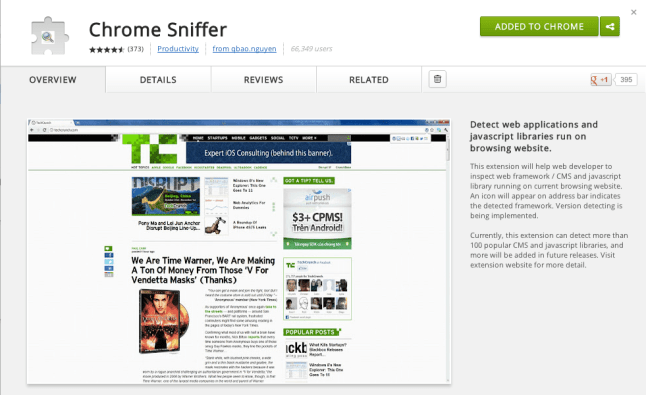
The code for the extension itself is GPL and the project lives at nqbao.com/chrome-sniffer.
Here is what my address bar looks like when I visit my own blog after installed the Chrome Sniffer extension:

For Firefox users, a similar extension is available at wappalyzer.com. And if you don’t want to install anything, you can manually paste in web addresses into ismyblogworking.com and it will provide similar info plus a bunch of other useful bits.
So give it a shot, you’ll be surprised to see what powers the sites you visit each day.
Black & White Ball in San Francisco
Shout-out to to Matt for being a great host for the evening.
-

- img 0899
-

- img 0902
-

- img 0910
-

- img 0916
-

- img 0918
Reblog: The experience economy – Chris Dixon
The experience economy
Before World War 2, the middle-class in the developed world struggled to afford basic needs. In the post-war boom, standards of living rose dramatically, and people consumed far beyond what they needed. It was the age of conspicuous consumption: a race to own bigger cars and houses, and accumulate more stuff. The mean income in the developed world became sufficient to provide for a comfortable life.
Today, people increasingly realize they own more than enough stuff, and don’t want to pay for feature-rich versions of that stuff. Four blades in your razors are enough. In the language of Clay Christensen’s disruptive innovation framework, the product economy overshot the mass market’s needs.
An economy of experiences is emerging in its place. Experiences make people happier than products (a fact that scientific studies support). The popularity of experiences like music concerts has skyrocketed compared to corresponding products like music recordings. Apple, the most valuable company in the world, maniacally focuses on product experiences, down to minute details like the experience of unboxing an iPhone…
A really smart interview
 Raanan Bar-Cohen
You must be logged in to post a comment.