5 Years at Automattic

Thanks to my wonderful colleague Mo who reminded that I’ve now been @ Automattic for 5 years !

I can’t imagine having a better job and a better set of colleagues to work with — I’m looking forward to the next 5 years.

And as I did after my one year anniversary, here are some fun stats to look at:

Biggest traffic day:
May/June 2007 – 8 million pageviews
May/June 2008 – 35 million pageviews
May/June 2012 – 130 million pageviews

Number of blogs on WordPress.com:
May/June 2007 – A bit over 1 million
May/June 2008 – 3.3 million
May/June 2012 – 32+ million

Unique Monthly Visitors to WordPress.com:
May/June 2007 – 40 million
May/June 2008 – 168 million
May/June 2012 – Over 350 million

How to Know What Powers that Website

Over on W3Techs they do great work analyzing which platforms power the top 1 million sites.

It’s a fascinating bunch of stats and insights into what is going on, and WordPress as a platform has the top spot with 16.6% overall, and over 54% of the content management systems:
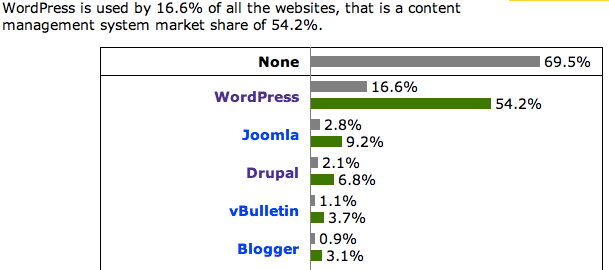
It’s hard to visualize that 16.6% number which is nearly 6 times larger than the next platform. It’s also very hard to know when you are on a WordPress powered site.

Unlike Twitter or Facebook which always have “twitter.com” or “facebook.com” in the address bar, tens of millions of WordPress sites are either self-hosted running their own domain, or on WordPress.com and running a mapped domain (as I do on this blog). So just because a site doesn’t live on “example.wordpress.com”, doesn’t mean it’s not using WordPress.

So how do you know when you are visiting a WordPress powered site ? You can view-source and look for some specifics, or check the http headers — but most of us won’t be doing that on a typical basis.

But there is an easier way. If you are running the Chrome browser, an extension called Chrome Sniffer will show you what is powering the site you are visiting by placing a small logo of that platform/service in the address bar:
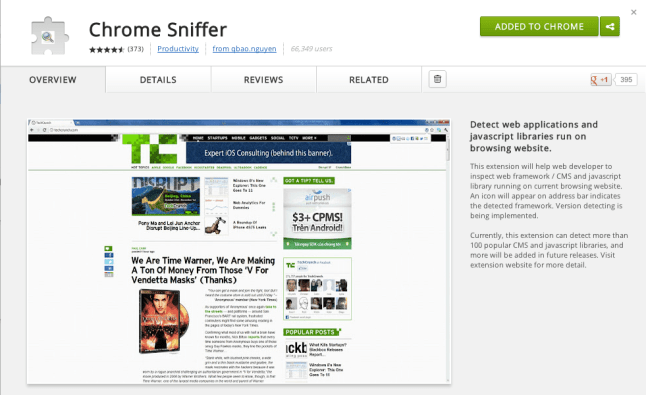
The code for the extension itself is GPL and the project lives at nqbao.com/chrome-sniffer.

Here is what my address bar looks like when I visit my own blog after installed the Chrome Sniffer extension:

For Firefox users, a similar extension is available at wappalyzer.com. And if you don’t want to install anything, you can manually paste in web addresses into ismyblogworking.com and it will provide similar info plus a bunch of other useful bits.

So give it a shot, you’ll be surprised to see what powers the sites you visit each day.

Black & White Ball in San Francisco

Shout-out to to Matt for being a great host for the evening.

Quote

Reblog: The experience economy – Chris Dixon

The experience economy

Before World War 2, the middle-class in the developed world struggled to afford basic needs. In the post-war boom, standards of living rose dramatically, and people consumed far beyond what they needed. It was the age of conspicuous consumption: a race to own bigger cars and houses, and accumulate more stuff. The mean income in the developed world became sufficient to provide for a comfortable life.

Today, people increasingly realize they own more than enough stuff, and don’t want to pay for feature-rich versions of that stuff. Four blades in your razors are enough. In the language of Clay Christensen’s disruptive innovation framework, the product economy overshot the mass market’s needs.

An economy of experiences is emerging in its place. Experiences make people happier than products (a fact that scientific studies support). The popularity of experiences like music concerts has skyrocketed compared to corresponding products like music recordings. Apple, the most valuable company in the world, maniacally focuses on product experiences, down to minute details like the experience of unboxing an iPhone…

via The experience economy – Chris Dixon.

The Man Who Makes the Future: Wired Icon Marc Andreessen | Wired.com

Andreessen: My bet is that the positive effects will far outweigh the negatives. Think about Borders, the bookstore chain. Amazon drove Borders out of business, and the vast majority of Borders employees are not qualified to work at Amazon. That’s an actual, full-on problem. But should Amazon have been prevented from doing that? In my view, no. Because it’s so much better to live in a world where that happened, it’s so much better to live in a world where Amazon is ascendant. I told you that my childhood bookstore was something you had to drive an hour to get to. But it was a Waldenbooks, and it was, like, 800 square feet, and it sold almost nothing that you would actually want to read. It’s such a better world where we have Amazon, where everything is universally available. They’re a force for human progress and culture and economics in a way that Borders never was.

Anderson: So it’s creative destruction.

Andreessen: When Milton Friedman was asked about this kind of thing, he said: Human wants and needs are infinite, and so there will always be new industries, there will always be new professions. This is the great sweep of economic history. When the vast majority of the workforce was in agriculture, it was impossible to imagine what all those people would do if they didn’t have agricultural jobs. Then a hundred years later the vast majority of the workforce was in industrial jobs, and we were similarly blind: It was impossible to imagine what workers would do without those jobs. Now the majority are in information jobs. If the computers get smart enough, then what? I’ll tell you: The then what is whatever we invent next.

via

The Man Who Makes the Future: Wired Icon Marc Andreessen | Epicenter | Wired.com.

Automattic Growth: New CFO & General Counsel

Lots of coverage today on some excellent new hires that we just announced (General Counsel & CFO) and some revenue numbers that we shared.

Our very own Matt Mullenweg puts it well:

Liz Gannes writes for AllThingsD, Automattic Grows Up: The Company Behind WordPress.com Shares Revenue Numbers and Hires Execs. In addition to Stu joining as CFO and Paul as Consigliere/Automattlock, we’ve been on a hiring roll the past month or two with excellent folks joining at every level of the company, including two more Matts. If you’re passionate about Open Source and making the web a better place, like we are, there’s never been a better time to join. My favorite thing about logging in every morning is the people I work with. Friends say I work too much but it hardly feels like work at all. Update: Now in Techcrunch too

via http://ma.tt/2012/04/automattic-growth/