Category Archives: rant

Uber and Waze need to start dating

uber-waze-datingEveryone knows I love Uber – better than a taxi in almost all respects, and about the same price for rides longer than 10 minutes (and often cheaper than a taxi for even longer rides). I’m equally obsessed with Waze – a crowd sourced community based GPS/traffic/navigation app that navigates you around traffic, alerts you to accidents, and ultimately gets better the more people use it.

If you are like me, you will occasionally find yourself sitting in the back of an Uber loading up Waze to see how long it will take to get to your next meeting or if you’ll catch your flight. And what you often find is that the driver, although well intentioned and very knowledgeable of the city, doesn’t have a full 360 view of ongoing traffic patters and accidents, and can’t pick the best route the way the Waze app can. A true #firstworldproblem :) .

So you watch your ETA slowly get later, and you hesitate to give the driver some advise on routes without coming across as this arrogant back-seat-driver.

When I see this happen I usually ask the driver if he or she has heard of Waze — and about 5% of the time they have but they rarely have it available or installed.

So my suggestion: Uber should add a “Waze option” where it’s bundled on the iPhone of the driver, or integrated into the app itself – and give the passenger the option of having the Uber driver just follow the best route as chosen by Waze.

It’s a an easy win for both companies, and gives peace of mind to the passenger.

When the very best becomes the minimally acceptable

In the physical world, when you shop at a bodega you don’t instantly compare it to an experience at a high-end Dean & DeLuca. When you purchase headphones at the airport, you don’t compare it to the selection and speed of buying something at B&H.

But when we consume digital services or buy stuff online, something radically different happens — at least to me. I get very disappointed when any service doesn’t deliver what the very best service out there is doing. It’s to the point where I change my behavior or try to convince others to adopt the very best. It’s unfair, and doesn’t mirror the offline world, but it’s happening and I suspect it’s driving lots of consumer behaviors these days.

For example, when I purchase any physical product online, I expect shipping to take 2 days max, maybe even just one day. Which is what Amazon/Zappos has trained me to expect. Any service that doesn’t do that, will cause me to double check if I can’t just buy the same thing on Amazon.

I’m a huge fan and user of Uber Conference which allows you to do conference calls with a visual browser interface, provides stats, easy calendar hooks, and calling-in from Chrome. Now when I have to use some other conf calling service with a 10 digit ID and no way to see who is talking – I feel underserved. I try to get the sender of the conf info to switch.

So what’s the conclusion ? Bigger marketshare for the leading services ? Probably. Build something that is at least as good as what the very best is offering ? Yes, but tough to pull off on all fronts.

I think one definite answer to all of this is to do deeper integrations with the very best and build on top of these platforms. If you sell physical stuff, work with Amazon Fulfillment or something similar. Doing voice services, start with integrating Twillio. Building a publishing app, build on top of WordPress.

Otherwise I think you’ll find that your customers are going to turn away when a certain core feature isn’t the best.

Every device needs a guest mode

How many times have you handed over your iPhone or iPad and wished it had a guest mode that allowed that person to use Safari and other apps but w/o your credentials, and without all your alerts, settings, etc ?

Seems like a super useful & social thing, and with alerts, check-ins and other 1-click actions on a device — it’s harder and harder to use someone elses’s device without it buzzing and interrupting every 30 seconds.

The only device I’ve seen so far that had a guest mode was an early Chromebook prototype that I received a couple of years ago:

And looks like they kept that feature:

Chromebooks also offer the ability to browse without signing in. We call this function Guest Mode. When Guest Mode is used, Chrome runs with the usual privacy measures of incognito mode, but none of the browsing data, including downloads, will stick around. When you exit Guest Mode or reboot your Chromebook, the browsing data is deleted.

Strange that iOS doesn’t have this built-in.

Eight Things to Fix in Offline Google Mail

Way back when, I used to use Google Gears to run gmail in offline mode in Firefox – usually when on a plane without wifi. Eventually Gears was retired, and a while after that, Google released a chrome app called Offline Google Mail that looked to do most of what you could once do with Gears.

I know I can install Thunderbird or run Mac Mail to do email offline, but I like the idea of using just my browser and not installing or running other client apps.

So on a recent trip Virgin America had non functioning wifi, and on the other leg it just barely worked. So I figured I’d put Offline Google Mail through it’s paces. What I found was pretty lacking and I took some notes :)

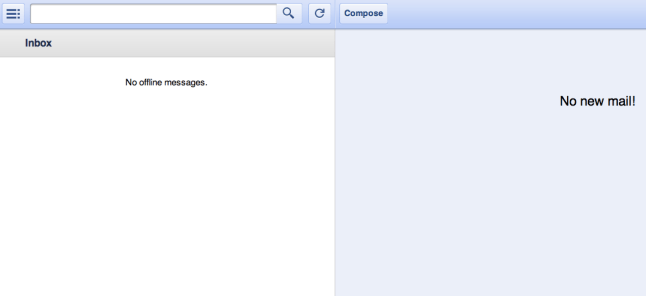
  • 1) This is a biggie. It won’t work if you are offline ! WTF you may say ? “Offline” is in the app name. Yes, but to make it work, you need to first launch the app while you are online and then keep the browser open. Otherwise you see some version of the screenshot above.  This seems like something that has to be fixed — as you never know when you might need offline access, and certainly don’t want to have to plan for it.
  • 2) Reply-all always CCs me the sender. Small thing, but annoying to have to remove yourself each time if there is more than one person on a thread.
  • 3) native spell checker doesn’t work.
  • 4) can’t force plain text mode in reply, you get stuck in this visual/rich mode which I’m not a fan of
  • 5) no option to send & archive, which is my default in gmail
  • 6) A biggie. It doesn’t detect the email address (i use multiple ones) to which the email was sent to. Unlike desktop gmail – which replies from the account the email was sent to
  • 7) When I click save, it picks a different time zone than my machine’s. Maybe that’s a gmail/calendar thing — but causes confusion.
  • 8) Another biggie. It doesn’t download attachment or images, clicking “show images” doesn’t do anything. Would love an option to include attachments.

Too bad it’s not open source — could send in patches :)

Anyone else have a better setup or recommendation ?

I see other complaining too:

Ideas on how Fedex/Kinkos Can Go Digital

I should preface this by saying there is nothing wrong really with Fedex/Kinkos today.

It’s more that it dawned on me that 10 years ago I used to frequent a Kinkos about once a week back when I ran my own web agency in NY, and that today I can’t recall the last time I actually visited a location except for an emergency fax ( which needs to be a whole separate post soon ).

So back in the day I would head over to Kinkos to print out high quality presentations for a big pitch, and then walk down the street and messenger or FedEx it over to the perspective client. Today, nearly nothing like that is printed out anymore, and if you do need to print for some reason, those capabilities are largely available as cheap laser printers for home office use.

So what could Kinkos/Fedex do to get me back as a customer ?

Pretty simple, it should focus on services that are out of reach and require expensive hardware or infrastructure, just as it did 10 years ago. Three ideas:

  • All locations should be equipped with ultra fast broadband. I’m talking 100 gig/sec Japan style connectivity. This could be used for sending massive video files, doing an initial huge backup of a HD to Amazon / Jungle Disk / Mozy / DropBox. I’m sure lots of people would come in with their laptops to do some high bandwidth activities.
  • Just as people used to come into Kinkos to get their first set of business cards printed, Kinkos today could offer a digital equivalent. Call it the Biz starter package. It would include a WordPress.com site with a couple of upgrades (domain plus Video perhaps ), some Google Ad Word buys, and maybe a handful of analytics reports from Quantcast and others showing you what your online competitive space looks like
  • High quality digitization and scanning. There are tons of businesses popping up around scanning your old photos, and converting old VHS home movies to DVDs. Kinkos has the real estate advantage of being everywhere. And while they offer some of this today with photos, I think they could expand this into something greater.

Bear Stearns News and the Role of Economic Models and Predicitions

Pretty dramatic news tonight that JP Morgan has acquired Bear Stearns. After Bear Stearns was trading in the 90s just a few months ago, this sale represents a purchase by JPM at a $2/share price — wow !

[ Begin Rant ]

Right after I read that, I saw an article in the FT, that Alan Greenspan thinks our financial models were partly at fault for this housing / loan crisis, and that better statistical models & better data in the future will help improve the stability of our markets (although he acknowledges that we’ll “never have a perfect model of risk”):

The most credible explanation of why risk management based on state-of-the-art statistical models can perform so poorly is that the underlying data used to estimate a model’s structure are drawn generally from both periods of euphoria and periods of fear, that is, from regimes with importantly different dynamics.

If we could adequately model each phase of the cycle separately and divine the signals that tell us when the shift in regimes is about to occur, risk management systems would be improved significantly

Greenspan is obviously a guru and a huge figure of our time — Bob Rubin’s book that I read a few years ago, In an Uncertain World: Tough Choices from Wall Street to Washington, had some great insights into how Greenspan operates.

But this general idea that better models are the solution strikes me as counter intuitive. There is a whole debate in certain quarters about economics being a hard or soft science — that is, is it closer to psychology and philosophy (soft – about trends / ideas / different for each person or situation – no less important a science, but not about injecting repeatable test-driven methodologies) or closer to math and physics (hard – repeatable tests, about math & data, etc). I tend to think it’s a softer science for a few reasons:

1) With nearly every economic model there is an underlying assumption that people will act in an economically rational way. That they will maximize their economic situation. We simply know this to not be the case. People overspend, overreach, and are easily manipulated into doing things that are absolutely not economically rational. Having a killer sound system in a beat-up broken down car is just one example :) Investing money in the markets while carrying high interest credit card debt is another common and simple example of not being economically rational.

2) If somehow you could build a model that took in every data point, you would need infinite data points. You would need to model in the probability of a new york sports team winning and how that will impact $$ spent in bars in NYC, and will therefor impact real estate in the east village. Just seems out of our current reach — the perfect model needs to encompass the entire real world.

3) Economic models on future events have been mostly wrong, and continue to be wrong – regardless of source – government & private sector. Stock pickers tend to be wrong over the long run, as index funds have been shown to do much better. Basically the finance experts who have tons of resources, sophisticated models, and 100% focus have a pretty bad hitting average. A friend of mine works in energy and told me that all the economic and financial prediction models that are put out are basically useless to his trading strategy & that I should look up up oil price estimates from the major banks in 2006. A quick google search and I found this from a top 3 bank:

We have increased our projection for prices of crude oil (WTI) for 2006 and 2007 from $50.00/bbl to $57.50/bbl and $45.00/bbl to $55.00/bbl, respectively.

Not even close — we are well over $110 today for WTI

I don’t necessarily have the answers on how to do it better — but it’s worth looking at the track record of the experts and perhaps not being as surprised when they get everything wrong and their models fail to predict the outcomes that we see.

But to me the inspiring part of this situation is that the US is the best positioned economy to deal with any challenges that lie ahead. In the US companies fail fast (the whole JP Morgan deal took 3 days basically over a weekend ). By failing fast and dealing with it, reallocation of capital can happen efficiently and expeditiously. Other economies are saddled with slow processes that keep failing companies on life support for years and actually suck energy out of the economy and prevent smart people from going to work for companies that should be thriving.

[ End Rant ]

Then again — I could be totally wrong :) I’m also influenced right now by a book I just started reading the other day, The Black Swan, that takes a very similar line towards economic models and predictions. I’ll write up a few thoughts on that book soon.


Skype Spam

I really like Skype. In fact, I think it has the best IM client on top of the killer VoIP calling features. So I guess it’s not surprising that spam is invading IM/VoIP. We see lots of web spam being thrown against blogs, wikis, and social networks — and thankfully services like Akismet are effectively zapping it.

So what about IM/VoIP Spam ? I’ve been getting 3-4 mostly Not Safe For Work (NSFW) Skype IM requests per week, with a few casino offers as well, and it seems to be increasing in frequency. Here is a typical looking one I got only a few minutes ago:
skype spam

It’s not unmanageable right now – you just click “block” and it closes that current spam request. And in fact, I went ahead and changed all my privacy setting in Skype to only allow communication from authorized contacts — so that should help (update: even with all the privacy settings turned on I got another spam IM :( ). But it does add an extra layer and potentially makes it harder for people to reach me.

Jim Higdon over at VoIP News suggested the same approach to combat this spam and predicts more problems in the future:

No End in Sight

Given that Skype spam appears to be a widespread trend, there isn’t much any one person can do to stop it, other than blocking the offending user. But that defense is akin to swatting mosquitoes in a swamp: You’ll run out of swat before the swamp runs out of mosquitoes.

You could try using one of these 10 alternatives to Skype. But, if you’d rather stick it out, you might be forced to batten down your Skype hatches and only allow messages from people you know. Go to Preferences > Privacy and set “allow instant messages from” to “only people whom I have authorized to start.” You won’t get any pleasant Skype surprises anymore, but maybe you won’t get any unpleasant surprises either.

And of course, like its complete lack of real-time customer service, Skype has no “report this user” function. So, you Skypers are on your own.

Waiting for Mac OS X Leopard: Why no digital download option ?

OS X Leopard imageThe newest version of Mac OS X “Leopard” is out in the wild, but my Amazon.com order has an estimated delivery date for next week.

Not a big deal, but made me think: In today’s world of broadband and on-demand user behavior, why doesn’t apple offer a digital download option ? On top of it, it’s environmentally more responsible to do away with all the extra packaging, fuel costs for shipping, etc.

As far as expertise and DRM issues, Apple has the experience with it’s iTunes store and .Mac service to offer this kind of option and make it secure.

In the gaming space I’ve seen Valve‘s digital efforts evolve over the last few years into a really impressive offering. They have a service called Steam (gigaom review) which essentially allows you to purchase games and download them instantly. They also use the service to foster online gaming, do auto patching, premier game trailers, and fight against cheats. It was initally conceived because they had trouble with 3rd party distribution, and ironically today Steam is used as a distribtuion platform for other game publishers.

The other company that could also facilitate this would be Amazon themselves. They distribute music digitally with their new amazon mp3 store – so why not do the same for software ?

left lane hoggers

Just a quick follow-up to my fun drive to DC w/ GPS.

I drive rarely, but when I do it’s often more than a quick spin — usually to DC, NJ, or someplace like that. The rest of the time I take mass transit, which, like all new yorkers, makes me a green citizen:

New York City… is responsible for 1% of the nation’s total greenhouse gas emissions.[2] They city’s levels are nevertheless relatively low when measured per capita, at 7.1 metric tons per person, below San Francisco, at 11.2 metric tons, and the national average, at 24.5.[2]

But I digress.

*begin rant*

When I do drive and run into traffic, it’s usually on a two or three lane highway, and without fail I see a fundamental driving error being committed by 95% of the drivers — they “hog the left lane”.

The left lane is for passing. It’s not for simply driving 5 miles above the speed limit, or slightly faster than the right lane traffic. Continue reading

FPS games, a look back and why I seem to still need a keyboard + mouse

WASDFirst Person Shooters ( FPS ) games are great, and it’s the genre that I really got into for a while — mostly in my late high school / early college years. The first game in this genre that really grabbed me and put me in this zone was the FPS game Wolfenstein 3D, followed by Doom ( modem to modem style ), and then my big time waster QuakeWorld w/ Threewave CTF ( old timers remember that QuakeWorld was an optimized Quake version for 56K/ISDN usage /200+ms ! Until QuakeWorld, the folks at id were all playing on T1s and had no idea what lag was like on a 56K connection ).

I played Wolf3d, Doom, and Quake1 all with a keyboard, no mouse. I used tons of keyboard shortcuts for certain moves, and it felt crazy to not use a joystick, but it all seemed to work great, and I was always near the top of the list for any given game.

Then came the 3dfx grafx card that I had to have, and it really changed the PC gaming scene. 3dfx was formed by a bunch of former SGI folks, who wanted to bring big time 3D grafx to the masses. The first generation Voodo card was an add-on card that kicked in any time you fired up a 3d game, and it really upped the stakes ( brought OpenGL into the mainstream too ), and made 3d style games look great and feel much more immersive.

All of the sudden I actually wanted to look around in 360, and I made the switch to keyboard + mouse, using what was then called WASD ( W to move forward, A for left, S for back, and D for right ). The mouse acted as my viewpoint, so that I could now move at will, and look anywhere. Capture the Flag (CTF) QuakeWorld games also introduced a grapple that made the maps much more 3D and meant that you had to be aware of your surrounding – and be ready from any angle.

And so the controls were set, a super fast laser powered mouse, plus a few simple keyboard keys, and every FPS I played from that point on – Quake2/3/Arena/UT mods, and Halife 1/2, were controlled in the very same way.

It became like second nature to play keyboard+mouse, and the pro players, and tournaments that followed, all were based on a similar controller setup.

I then fell out of gaming as RealLife took over, random free time was diminished, $$ spent on upgrading a PC seemed like an irrational thing, and the overall learning curves for games seemed to get higher and higher.

I didn’t play much of anything for a while, until I received a PS2 as a gift. I dipped my toe back in, mostly playing sports games, but tried a few FPS games as well. Sports game were great with a console’s controller, but FPS games seemed just wrong. I needed my mouse + keyboard, and I needed a true FPS angle, not this 3rd person stuff that seems to be the rage on consoles.

I’ve now picked up an Xbox360 – and if I’m lucky I get to play 1 hr per month. I still enjoy sports games – Tiger Woods, Fifa, etc — but I kept reading about how great Gears of War was – so I picked that up too. And yes, it’s a great looking FPS game on my 40″ LCD HD, but the controls still seem all wrong ! I’m pretty good at learning new things, but how do you aim with precision when it’s a controller ( hint: many of these games auto aim for you ).

What’s wild is to see a generational shift from keyboard+mouse –> console controllers all because of one game — Halo. People who grew up in gaming with an Xbox have only played with a controller and look at us old guys as relics. To be fair, there are some hardcore gamers out there that say “get a keyboard+mouse and hook it into the Xbox360″ – gizmodo reviewed such a product, and the comments could have come from me:

“I always prefer keyboard and mouse – more controls, more configurable, easier to combo. Not to mention that I’ve spent/wasted way too much time honing my keyboard/mouse skills in Quake to give it up.”

Fantastic idea. I’m a PC gamer and could never see myself using the standard Xbox controller for FPS’s. This has me one micron closer to a console, but for now i’m sticking with the PC

I’m personally not keen on introducing more gadgets that into the living room, but I do wonder how many people do that.

So not sure if I’ll ever quite master using a controller for FPS games on the console. And maybe that’s not such a bad thing — as RealLife does have many advantages over gaming :)