Category Archives: automattic

USC Talk & a surprise about Snapchat usage

I gave a talk at USC earlier this week about Automattic and WordPress — something I’ve done for 3 years in a row now.

It’s always a ton of fun, and I make sure to do a survey (by show of hands) each time to see what these undergrad & grad students are using in terms of popular services.

Here are the results:
- WordPress: about 75%+ use WordPress in some capacity
- Facebook: 100%
- Twitter: about 75%
- Tumblr: 33%
- Note taking: Evernote vs Simplenote vs Pen & Paper: About 33% Evernote, the rest a combination of email, other apps, or nothing. And one person still using a pen & paper.
- iOS vs Android: 75% iOS, 25% Android
- SMS vs GroupMe vs MessageMe vs Snapchat: SMS still used by everyone, but the surprise here was Snapchat being used by over 50% of the class.

I asked the obvious question of what they were using Snapchat for – and the answer was that it was just a free SMS-like service, easy to send media, works all over the world and w/ friends overseas — and basically that everyone is on it. Was pretty clear it’s moved beyond the salacious roots (or at least how it was covered early on).

So a big thanks to Zach Posner for having me, and for his entire class for engaging in a really fun and interesting discussion – appreciate the tweets and Instagrams too :)

Thanks for the awesome #wordpress presentation at #APOC2013, @raanan!

WordPress and Politics Plus DNC 2012 Pix

For this election cycle, both the DNC and RNC powered their sites with WordPress, and a good many candidates this year at all levels did as well. It’s a huge signal that among those building sites in politics who want to take advantage of great CMS capabilities, top notch social integration, and out-of-the-box search friendly content — that the natural choice is now WordPress..

For a bit more context, WordPress powered 40% of the sites involved with the US Senate races, 35% of Congressional races, and over 41% of Gubernatorial races. We just put together a great infographic, WordPress Powers Politics, that is worth checking out with more of these stats.

In terms of events, our WordPress.com VIP team was in Charlotte earlier this month at the Democratic National Convention. I was able to swing by for a couple of days of meetings and to get an overall sense on how our government is using WordPress.

This DNC was my first one, and I had also been to the RNC when it was held in NY in 2004 when I was working at TIME.

Here are a few pics that I took:

New Liveblogging Add-On for our WordPress.com VIPs

Really excited about this new feature that the VIP team built – and just in time for Apple’s September 12th announcement :)

More details on vip.wordpress.com/liveblog-add-on/

5 Years at Automattic

Thanks to my wonderful colleague Mo who reminded that I’ve now been @ Automattic for 5 years !

I can’t imagine having a better job and a better set of colleagues to work with — I’m looking forward to the next 5 years.

And as I did after my one year anniversary, here are some fun stats to look at:

Biggest traffic day:
May/June 2007 – 8 million pageviews
May/June 2008 – 35 million pageviews
May/June 2012 – 130 million pageviews

Number of blogs on WordPress.com:
May/June 2007 – A bit over 1 million
May/June 2008 – 3.3 million
May/June 2012 – 32+ million

Unique Monthly Visitors to WordPress.com:
May/June 2007 – 40 million
May/June 2008 – 168 million
May/June 2012 – Over 350 million

How to Know What Powers that Website

Over on W3Techs they do great work analyzing which platforms power the top 1 million sites.

It’s a fascinating bunch of stats and insights into what is going on, and WordPress as a platform has the top spot with 16.6% overall, and over 54% of the content management systems:
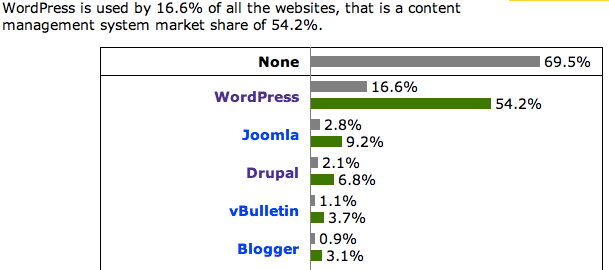
It’s hard to visualize that 16.6% number which is nearly 6 times larger than the next platform. It’s also very hard to know when you are on a WordPress powered site.

Unlike Twitter or Facebook which always have “twitter.com” or “facebook.com” in the address bar, tens of millions of WordPress sites are either self-hosted running their own domain, or on WordPress.com and running a mapped domain (as I do on this blog). So just because a site doesn’t live on “example.wordpress.com”, doesn’t mean it’s not using WordPress.

So how do you know when you are visiting a WordPress powered site ? You can view-source and look for some specifics, or check the http headers — but most of us won’t be doing that on a typical basis.

But there is an easier way. If you are running the Chrome browser, an extension called Chrome Sniffer will show you what is powering the site you are visiting by placing a small logo of that platform/service in the address bar:
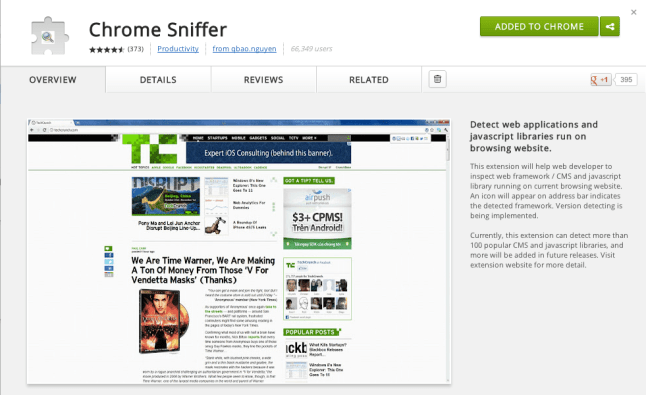
The code for the extension itself is GPL and the project lives at nqbao.com/chrome-sniffer.

Here is what my address bar looks like when I visit my own blog after installed the Chrome Sniffer extension:

For Firefox users, a similar extension is available at wappalyzer.com. And if you don’t want to install anything, you can manually paste in web addresses into ismyblogworking.com and it will provide similar info plus a bunch of other useful bits.

So give it a shot, you’ll be surprised to see what powers the sites you visit each day.

Automattic Growth: New CFO & General Counsel

Lots of coverage today on some excellent new hires that we just announced (General Counsel & CFO) and some revenue numbers that we shared.

Our very own Matt Mullenweg puts it well:

Liz Gannes writes for AllThingsD, Automattic Grows Up: The Company Behind WordPress.com Shares Revenue Numbers and Hires Execs. In addition to Stu joining as CFO and Paul as Consigliere/Automattlock, we’ve been on a hiring roll the past month or two with excellent folks joining at every level of the company, including two more Matts. If you’re passionate about Open Source and making the web a better place, like we are, there’s never been a better time to join. My favorite thing about logging in every morning is the people I work with. Friends say I work too much but it hardly feels like work at all. Update: Now in Techcrunch too

via http://ma.tt/2012/04/automattic-growth/

Reblog: The Return of My Unsolicited Annual Plug for WordPress.com

Nice post from John Scalzi:

Today marks the third anniversary of Whatever’s association with WordPress.com, via its VIP hosting service, and the best compliment I can think to give WordPress.com in this regard is that it’s been three years since I’ve had to think about whether my blog is up and running.

via The Return of My Unsolicited Annual Plug for WordPress.com – Whatever.

Retro MacOS WP.com Theme Enabled

My colleagues worked overnight on making this theme available to all of WordPress.com, and I just enabled here on raanan.com:

Yesterday one of the tributes I noticed was the website Boing Boing (WordPress powered) switched their theme to one reminiscent of the original Macintosh interface, one of the several times Jobs would make a ding in the universe through his work. It seemed fitting, and we wanted to make it available to all of you, so our theme team worked through the night and here it is:

More details on the announcement post

vacation

Why don’t we take much vacation in the U.S ? A few theories

On this labor day holiday, saw a tweet from Bill Maher that caught my eye:

And then happened to catch a short video clip from Fareed Zakaria on CNN on the same topic. In this video he summarizes that:

Nowadays the average European gets about three times as many days of paid vacation as his counterpart in America. Italy has the most vacation days, with the average worker there getting 42 paid days off, according to the World Tourism Organization. Next was France with 37 days, Germany with 35, Brazil at 34, the United Kingdom at 28, Canada with 26 and Korea and Japan both with 25. The United States was near the bottom of the list with the average worker getting 13 days off.

He goes on to say:

Why do we do this to ourselves?

The conventional answer is that this attitude toward work makes the American economy the envy of the world. America has a hectic, turbo-charged system that builds, destroys and rebuilds, all at warp speed. It’s what created the information revolution, Silicon Valley, hedge funds, biotechnology, nanotechnology and so on. And there’s no time in it for lolling on the beach!

In fact, it’s not clear at all that working for a few extra weeks in the summer is what makes a nation’s economy hum. The consulting firm Ipsos gives us numbers on the percentage of paid vacation days that were used up by the end of the year. The French predictably lead the pack, taking 89% of their vacations days. But Germany, which is growing briskly, takes 75%. Indonesia, which has been booming, takes 70%. And the U.S. – just 57% – and it has fewer paid vacation days than almost all major countries. But even with those 13 days off, only 57 percent of Americans take them all. To remind you again, 89% of the French use all of their days off.

As someone who is terrible at taking vacation I have a few theories of my own:

  • The days before a vacation and the days after a vacation can be so bad that it’s not worth it. In the run up to a vacation you try to squeeze everything in, and if you really disconnect while away, you come back to 20 fire-drills and an insane week that wipes out any relaxation you may have had.   Now that I work for a distributed company (love it, and we are hiring !) – I find that when I do “take a few days off”, I generally just work reduced hours, working a bit in the mornings and in the evenings, and then disconnecting during the day. Much more manageable and less chaotic, but also not a true ‘disconnect’ which would be nice from time-to-time.
  • Most US companies are pretty thinly staffed compared to European and South American ones. In the US it’s pretty common that there is no backup to a person when they are out – so the idea that work will grind to a halt may cause some people to forgo vacation.
  • And most importantly in my mind, there isn’t that accepted summer break that is common throughout the world. In parts of Europe it’s all of August, in some countries it’s the last 2 weeks of August, and I’m sure there are variations on that. In the US if we could all just agree that August 15th -> Labor day we ‘shut down’, it would make things much easier. Instead what I found in my previous jobs is that we planned launches and big projects right around September 1 — only to have most of the senior staff away those two weeks up in the Hamptons :)

TechCrunch relaunched on WordPress.com VIP

From Dave Feldman of TechCrunch/AOL:

THE CMS
One of my favorite things about WordPress is its extensibility. We’re on the same platform today as yesterday, but have built new tools for writers and editors. Featured and pinned articles get expiration dates, so editors don’t have to go back and manually un-feature things. Selecting a post layout is as simple as clicking a button. Automated resizing of images means faster load times and fewer distorted photos. And choosing which articles go on the home page is a single-click affair.

Impressive work by everyone involved. More details on the announcement post Redesigning TechCrunch: We Picked This Logo Just to Piss You Off